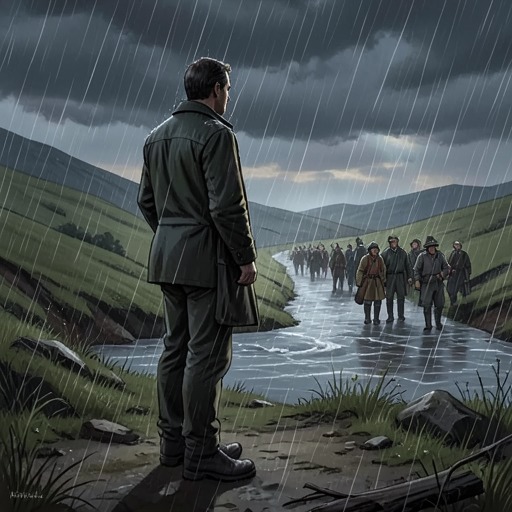
The Killary fjord flood
Dark Lies the IslandThe Killary fjord flood is the disaster at the Water’s Edge Hotel in which rapidly rising water isolates the hotel and forces its residents and guests to shelter upstairs. The flood’s significance lies not only in its threat to life but in the strange social world it produces: a community that initially disregards its anxious outsider eventually responds together, and a working disco becomes a refuge while the water climbs the stairs. The first sign of relief comes through a small change in the water level; for the narrator, that reversal coincides with the return of creative energy and an end to youthful gloom.
Background and Warning Signs
The narrator had bought an old hotel on the fjord of Killary, hard by the harbour wall, with Mweelrea across the water. Eight months into living there, amid skies described as disgracefully grey and rain said to fall 287 days a year, the narrator was already convinced the place might be the death of him. On the night of the flood, exceptionally violent rain set the crisis in motion. The narrator called it end-of-the-world weather, but the lounge-bar regulars ignored the fretful newcomer and listened instead to John Murphy, the local funeral director.
The first signs of danger came from the hillsides: dogs howled in a succession of cries that grew too loud to dismiss. The hotel’s guests and locals went to the windows. The roadway between the hotel and harbour wall had disappeared, and the last evening light took on an unreal green cast. Bill Knott, who had earlier been discussing the route out, now judged that the roads would be impassable. The storm had turned the familiar approach to the hotel into a barrier, leaving its occupants to reckon with the water rather than drive away from it.
Isolation and Rising Water
The group moved back from the windows in an oddly coordinated manner. People made quiet calls on their mobile phones and spoke in whispers as reports spread along the fjord that the water had risen and breached the harbour walls. Emergency services had been alerted, and sandbagging was discussed, but the response came late. Six of the nine Belarusians joined the people in the lounge bar; the other three had gone to a cinema in Westport. Two elderly couples also joined them after remaining in the library. The narrator offered drinks on the house, acknowledging that they might be stuck there for some time.
The water advanced into the hotel. Janey McAllister was unwell, and Norah Fettle and Vivien Harty tended to her while brandy was called for. At the windows, the group watched water pass the fourth step and sweep over the porch. Lights still shone across the harbour on the mountainside of Mweelrea, then went out. The danger was unusually confined: the fjord was flooding while the rest of the country continued its ordinary Monday evening, watching football or television, putting out bins, and going about domestic life. For those at the hotel, that contrast sharpened the sense of abandonment.
An escape route was considered, including a possible way around Lough Fee toward the N59, but the immediate problem was keeping water out. The Belarusians carried boxes of old curtains down from the attic to block the doorways. As soon as the last box reached the bottom of the stairs, the doors gave way and the waters of Killary entered. The narrator moved everyone upstairs to the function room, used occasionally for weddings. It had a stocked bar and working disco lights, and the group reached it just in time. The narrator followed at the rear, looking back toward the hotel and the darkness outside, then urged the others onward.
The Hotel Becomes a Shelter
Once upstairs, the narrator switched off the harsh strip lights and turned on the function room’s softer, moving disco lights. The bar opened, and the locals were willing to drink. This was not an evacuation from danger so much as an improvised way to remain together inside it: the room’s wedding and entertainment fittings became emergency resources, while the group waited for news and for the water to stop rising.
The narrator later returned to the function room and proposed having a disco. The group danced through the night to “Chiquitita,” “Brass in Pocket,” and “Summer of ’69,” moving from slow dancing to nostalgic steps and exuberant celebration. The festivity did not mean the danger had passed. The narrator found the six Belarusians sitting on the top stair, with the water halfway up the staircase; objects including footstools, toilet rolls, place mats, and phone books drifted through the lobby below. Back in the function room, the narrator continued serving pints as the flood rose.
The practical means of contacting help then failed: all mobile signals went down, and no rescuers appeared on the horizon. The disco therefore took place without reliable communication or visible assurance that assistance was coming. Its energy and the continuing flood occupied the same night. The function room offered shelter and shared activity, but the stairs kept registering how little distance remained between the group and the advancing water.
Recession and Personal Reversal
During the night, the narrator went out to check the level and encountered Alexei, one of the Belarusians, who pointed to the water on the stairs with a pleased gesture. It had dropped by a couple of steps. The narrator patted Alexei on the back, winked once, and returned to the disco. The relief was modest and measured against the staircase, not a declaration that the danger was over; nevertheless, it was the first concrete sign that the flood had begun to retreat.
The narrator sets this reprieve against the long life of the inn: it had already been operating in 1648, a year before Cromwell landed in Ireland, and had survived the disaster as well. That perspective shifts the flood from an apparently final catastrophe to one more crisis endured by a place with a history beyond the present occupants. At the same moment, the narrator experiences a sequence of phrases and images as the beginnings of a new idea, followed by a quiet ecstasy. The closing change is inward as well as environmental: the narrator says that the gloom of youth has at last lifted.
Narrative Significance
The flood moves through sharply contrasted stages: ignored warnings, a lost roadway, failed barriers, retreat upstairs, a party held under pressure, and the first small drop in the water. Its isolation is as consequential as its force. Although the emergency services have been alerted, the hotel group cannot depend on immediate outside rescue; the people present must share space, make improvised decisions, and live with uncertainty together.
The disco gives the crisis its distinctive double character. Familiar songs and old dance steps briefly restore a collective social life, while the water continues rising below and the Belarusians wait on the stairs. The celebration does not erase peril; its value comes from occurring alongside it. When Alexei points out the receding water, a gesture rather than an official announcement becomes the night’s clearest sign of hope. The flood thus marks both a communal ordeal at the hotel and a turning point in the narrator’s perception, ending in survival and renewed creative possibility rather than a simple account of rescue.